
Plants
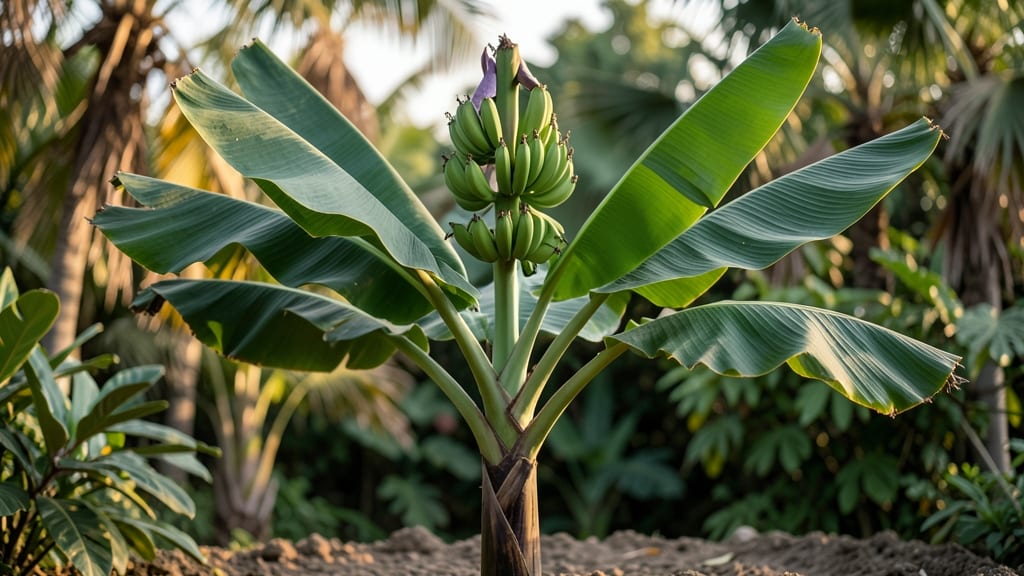
Bananas don't grow on bushes—they develop from massive herbaceous plants called banana trees, which reach heights of 15-25 feet and produce long, leafy stalks instead of branches. These plants belong to the Musaceae family and have a unique growth cycle that sets them apart from traditional shrubs.
Banana plants are often mistaken for trees because of their impressive size, but botanically they're classified as herbs due to their lack of woody stems. 🌱 Their iconic "trunks" are actually pseudostems made of tightly packed leaf sheaths that can grow up to 3 feet in diameter.
What's fascinating is their rapid growth—some varieties can reach maturity in just 9-12 months, producing massive flower spikes that develop into banana bunches. This growth pattern explains why they appear more tree-like than bush-like, despite their herbaceous classification.
The confusion stems from their towering height and leafy appearance, which makes them resemble small trees at first glance. However, their growth habit—producing a single large flower stalk that dies after fruiting—is more characteristic of giant herbs than traditional woody plants.
This unique lifecycle means each "banana tree" is actually a one-time producer, as the plant dies after harvesting its fruit.
💡 In This Article
- Why Banana Plants Are Classified as Herbs, Not Trees
- Growing Bananas at Home: Key Tips for Cultivation
Why banana plants are classified as herbs, not trees
Botanists classify banana plants as herbs because they lack true woody stems, despite their tree-like appearance. The iconic "trunk" you see is actually a pseudostem—a tightly packed structure of overlapping leaf sheaths that can grow 15-25 feet tall and 3 feet in diameter.
These sheaths provide structural support but are made of soft, fibrous tissue rather than hardwood, which is why botanists categorize them as herbaceous plants. 🌱
The confusion arises from their impressive height and leafy structure, but true trees have secondary growth (thickening stems from vascular cambium), while banana plants rely on their pseudostems for support. Their growth pattern is more similar to giant sunflowers or corn than to traditional trees.
The pseudostem's fibrous nature makes it flexible yet strong enough to support 40-50 pounds of banana bunches, which can weigh up to 100 pounds in commercial varieties.
What truly sets banana plants apart is their monocarpic lifecycle—they produce a single massive flower spike (called an inflorescence) that develops into the banana bunch, then the entire plant dies after fruiting. This is unlike bushes or trees that produce multiple growth cycles.
The flower spike itself can grow 12-18 feet long, with hundreds of tiny flowers that develop into bananas over 3-6 months, depending on the variety.
Here's where the science gets fascinating: banana plants belong to the Musaceae family, which includes about 70 species of flowering plants. Their leaves alone can reach 7-10 feet long and 2-3 feet wide, with a surface area equivalent to a small tablecloth.
These leaves provide most of the plant's photosynthesis while the pseudostem stores water and nutrients. The plant's rapid growth—some varieties can reach maturity in just 9-12 months—explains why they appear more tree-like than bush-like in their natural habitat.
Consider this comparison: while a bush like a raspberry plant produces multiple canes with woody stems that regrow annually, a banana plant puts all its energy into one massive growth cycle.
The pseudostem's fibrous structure allows it to grow rapidly in tropical climates where temperatures average 75-85°F and rainfall exceeds 50 inches annually. This growth spurt is what makes banana plants appear more dramatic than traditional herbaceous plants like basil or mint.
The botanical distinction matters because it explains why banana plants can't regenerate from their central stem—they're designed for a single, spectacular growth cycle rather than repeated harvesting.
This is why gardeners who try growing bananas often see their plants die after fruiting, even though they may produce 100-200 individual bananas per bunch. 🌿