
Pests and Diseases
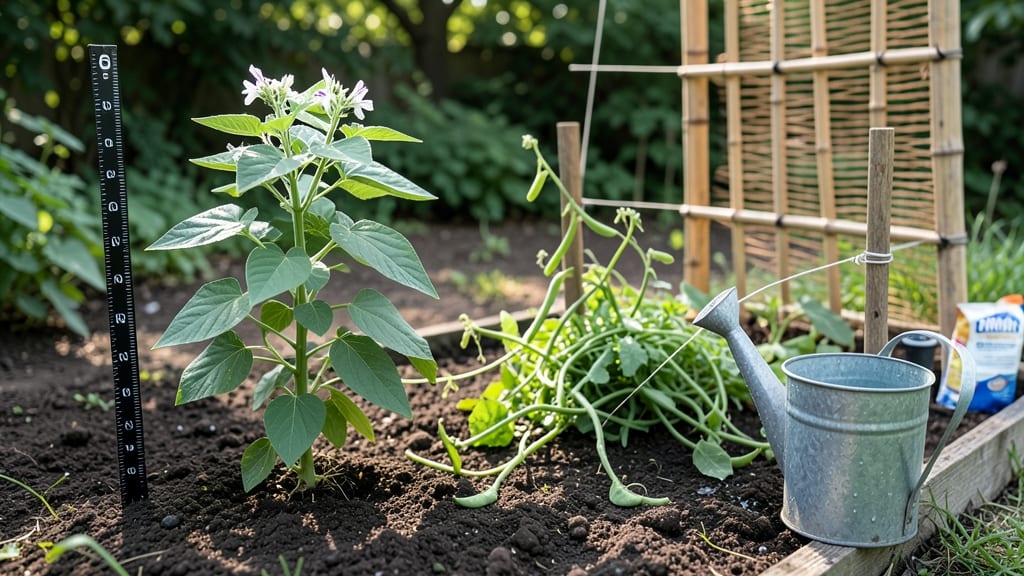
Your bush beans are vining because they're desperate for space. 🌱 Overcrowded roots trigger skyrocketing growth as plants stretch toward sunlight, leaving you with leggy, weak stems instead of compact bushes.
I've seen this happen when seeds are sown too close or seedlings aren't thinned properly—what seems like a small mistake turns into a harvest-limiting problem by midsummer.
The good news? This isn't a disease or pest issue—it's a simple fix. Bush beans need 3-4 inches of space between plants to develop properly. When roots compete, the plant prioritizes vertical growth over bushy foliage and pod production.
The solution starts with proper spacing at planting, but even established plants can be corrected with strategic pruning.
You'll notice the difference within 1-2 weeks of proper care: plants will thicken up, leaves will darken, and you'll start seeing more pods forming along the main stems. The key is balancing air circulation with sunlight exposure—both prevent that weak, stretching growth that makes beans less productive.
For next season, consider planting pole beans if you love vining varieties—they'll climb naturally without the same space constraints. Or try a bush bean variety with 'compact' in the name for guaranteed bushy growth. Either way, you'll end up with stronger plants that produce more consistently.
Root Stress Triggers Vining Behavior
When your bush beans start sending out long, sprawling vines instead of staying compact, it’s often a cry for help from their roots—not their leaves.
Unlike their pole bean cousins, bush beans are bred to grow in a bushy, self-supporting form, but when conditions stress their root systems, they revert to a survival strategy: climbing and vining. Here’s why this happens, broken down into the key culprits disrupting their growth equilibrium.
Bush beans thrive when their roots have room to spread and access nutrients efficiently. But when roots become overcrowded—whether from planting too closely, poor soil aeration, or competing plants—they struggle to absorb water and nutrients.
This triggers a physiological response: the plant prioritizes vertical growth (vining) over bushy development to escape the competition for resources.
Why it happens:
- Competition for nutrients: Roots in tight quarters must fight for nitrogen, phosphorus, and potassium. When these aren’t available, the plant shifts energy to produce longer stems to access light and air.
- Oxygen deprivation: Compacted soil restricts airflow to roots, leading to hypoxia (low oxygen). Roots can’t function optimally, so the plant redirects growth upward to maximize photosynthesis.
- Root-bound stress: If beans are planted too densely (closer than 4–6 inches apart), roots intertwine, stunting growth and forcing vining as a compensatory mechanism.
Actionable fix: Loosen soil around plants gently with a hand fork to improve aeration, or thin seedlings to give roots space. Add compost to boost nutrient availability without overcrowding.
Water stress—whether from overwatering or underwatering—disrupts root function and sends bush beans into vining mode. Roots need consistent moisture to absorb nutrients, but extremes throw their system off balance.
Why it happens:
- Overwatering: Soggy soil suffocates roots by displacing oxygen, leading to anaerobic conditions. Roots can’t process nutrients, so the plant focuses on above-ground growth to compensate.
- Underwatering: Drought-stressed roots struggle to transport water and nutrients upward. The plant reacts by producing longer vines to access moisture from deeper soil layers or to position leaves for better sunlight capture.
- Inconsistent moisture: Fluctuating water levels confuse the plant’s growth hormones (like auxins), prompting erratic vining instead of steady bush growth.
Actionable fix: Water deeply 1–2 times per week (1–1.5 inches total) to encourage deep root growth. Use mulch to retain moisture and prevent soil temperature swings.
Bush beans are sensitive to temperature extremes and light deprivation, both of which can trigger vining as a survival tactic. When conditions stray from their ideal range, the plant’s growth hormones shift priorities.
Why it happens:
- Cool soil temperatures: Roots struggle to absorb nutrients below 60°F (15°C). The plant may produce vines to warm up faster by positioning leaves closer to sunlight.
- Insufficient light: Shady conditions reduce photosynthesis, forcing the plant to stretch vines toward any available light source (a process called etiolation).
- Heat stress: Temperatures above 90°F (32°C) can scorch roots, limiting nutrient uptake. The plant responds by vining to cool down and access more air circulation.
Actionable fix: Plant in full sun (6+ hours daily) and use row covers for early/late seasons. For heat stress, provide afternoon shade cloth and ensure soil stays moist.
Bush beans are heavy feeders, especially for nitrogen, but an imbalance in soil nutrients—too much or too little of specific elements—can disrupt their growth patterns.
Why it happens:
- Nitrogen deficiency: Without enough nitrogen, leaves turn yellow, and roots weaken. The plant prioritizes vining to maximize light exposure for photosynthesis.
- Phosphorus or potassium shortages: These nutrients are critical for root development. A deficiency stunts roots, forcing the plant to grow upward for survival.
- Excessive fertilizer (especially nitrogen): While nitrogen promotes leafy growth, too much can burn roots, reducing their ability to absorb other nutrients. The plant then vines to escape the toxic soil environment.
Actionable fix: Test soil pH (aim for 6.0–7.0) and amend with compost or a balanced fertilizer (e.g., 10-10-10). Avoid high-nitrogen fertilizers unless soil tests confirm a deficiency.
💡 Pro Tip: If your bush beans start vining suddenly, check the roots! Gently dig around the base—if roots are tangled, mushy, or lack hair-like rootlets, you’ve identified the stressor. Adjust care accordingly, and you’ll see bushier growth in weeks.
Fix Your Vining Bush Beans Now
If your bush beans are suddenly vining like they’re racing to the sky, don’t panic—there’s a solution for every cause! Below, we’ve broken down the most common reasons your plants are acting like pole beans and how to stop the vining madness while keeping your harvest healthy.
Problem: Roots tangled in a tight space force beans to stretch upward for light. Fix:
- 🔪 Trim the vines at the base (about 6–12 inches from the ground) to redirect energy to bushier growth. Use clean, sharp shears to avoid damaging the plant.
- 📏 Thin the plants—keep only the strongest 3–4 plants per hill (if you’re growing in clusters). Remove weaker stems at the base.
- 🪴 Repot or transplant if roots are severely crowded. Gently loosen the root ball and replant in fresh, well-draining soil.
Prevention: ✨ Plant seeds 4–6 inches apart in rows spaced 18–24 inches apart. ✨ Use raised beds if your soil is dense—better drainage = happier roots. ✨ Mulch lightly (1–2 inches of straw or grass clippings) to prevent root competition with weeds.
Problem: Beans stretching toward light means they’re starved for sunlight (they need 6–8+ hours daily). Fix:
- 🏡 Relocate pots to a sunnier spot immediately. If in-ground, consider shifting the entire plant (dig carefully to avoid root damage).
- 🌿 Add shade cloth (30–50% coverage) if moving isn’t an option—this prevents extreme stretching while still allowing light.
- 🌱 Train vines upward by tying them to a small tomato cage or stakes (3–4 feet tall) to encourage vertical growth without sprawling.
Prevention: 💡 Choose the sunniest spot in your garden before planting. 🌡️ Monitor light levels—if shadows linger past noon, supplement with a reflective surface (like white plastic sheeting) to bounce light.
Problem: Overwatering weakens roots, making beans floppy and vine-prone. Fix:
- 💦 Cut back on water—bush beans only need 1–1.5 inches per week (including rain). Let the top inch of soil dry out between waterings.
- 🌧️ Water deeply but less often—soak the roots at the base (not overhead) to encourage deep growth.
- 🚿 Check drainage—if water pools, amend soil with compost or perlite to improve airflow.
Prevention: ✨ Use drip irrigation or soaker hoses to deliver water directly to roots. ✨ Water in the morning so foliage dries quickly, reducing disease risk.
Problem: Hungry plants stretch for nutrients, leading to leggy growth. Fix:
- 🍽️ Fertilize lightly with a balanced, low-nitrogen fertilizer (like 5-5-5) or compost tea. Too much nitrogen = more leaves, fewer beans!
- 🥔 Side-dress with compost—sprinkle a handful near the base (not touching stems) and water in.
- 🌱 Add calcium (like crushed eggshells or lime) if leaves look yellow or brittle.
Prevention: 🎯 Test your soil before planting—beans prefer pH 6.0–7.0. 🔥 Avoid fresh manure—it can burn roots. Use aged compost instead.
Problem: Bugs (like aphids or spider mites) or fungal issues sap energy, causing vining. Fix: - 🐜 Spray with neem oil (1 tsp per quart of water) to deter pests.
Reapply every 5–7 days. - 🌿 Remove infected leaves and dispose of them far from the garden (don’t compost!). - 💧 Improve airflow by pruning nearby plants or spacing them wider.
Prevention: 💡 Inspect plants weekly for early signs of pests (sticky leaves = aphids, yellow spots = fungus). 🌡️ Rotate crops—don’t plant beans in the same spot two years in a row.
If your bush beans refuse to stop vining, embrace their growth habit! - 🪜 Install a small trellis or cage (3–4 feet tall) and let them climb.
This can increase yield by 30%! - 🍽️ Harvest more frequently—picking beans encourages bushier growth. - 🌿 Prune aggressively—trim vines back by 1/3 to force compact growth.
Pro Tip: 🔥 Speed up recovery by giving your beans a foliar feed (like seaweed extract) to boost growth hormones naturally.
With these fixes, your bush beans should stop vining and start bushing in no time—ready for a bumper harvest! 🌱💚
Frequently asked questions
Could I have accidentally planted pole beans instead of bush beans?
It's possible! Pole beans and bush beans come from the same family, but they have distinct growth habits. Check the seed packet—pole beans need a trellis and grow 6+ feet tall, while true bush beans stay compact (1-2 feet). If you're unsure, dig up a plant: bush beans have bushy, multi-stemmed growth from the base, while pole beans have a single main stem.
Will pruning my vining bush beans actually help them grow bushier?
Pruning redirects the plant's energy from vertical growth to producing more lateral branches and pods. Trim the longest vines back by about one-third at the base, and you'll see thicker growth within 1-2 weeks. Just use clean shears and avoid cutting into the main stem unless absolutely necessary.
How can I tell if my beans are vining due to overcrowding vs. nutrient deficiency?
Look at the leaves and roots! Overcrowded beans show tangled roots when gently lifted, with healthy green leaves but weak stems. Nutrient-deficient beans have yellowing leaves (especially older ones), stunted growth, and may show purple tinges. Test your soil pH—if it's outside 6.0-7.0, that's likely your issue.
Can I still get a good harvest from vining bush beans?
Yes, but with adjustments! While they won't be as compact, you can still get plenty of beans by training them up a small trellis (3-4 feet tall) or harvesting more frequently. The pods will form along the vines, just like pole beans. Just be prepared to stake or cage them to prevent sprawling.
What's the fastest way to fix vining bush beans in my container garden?
For containers, the quickest fix is to thin to one strong plant per pot and add a small cage or stakes immediately. Then, water deeply but less frequently (let soil dry slightly between waterings) and fertilize lightly with compost tea. Move to the sunniest spot possible, and you should see improvement in 7-10 days.